

Investment Thesis and Summary
CMC Markets (CMCX) is a UK listed trading and investing platform, specialising in CFDs and spread betting, which is benefitting from recent volatility in the markets. It was recommended to Real Worth Stocks members in February 2026 at £3.20 per share, and now trades at £4.54 per share. In this article, the business and valuation are discussed to explain whether it is still a buy or a sell.
Business Model
CMC generates revenue in three main areas shown below, from spreads on financial instruments, commissions, and interest on client balances.
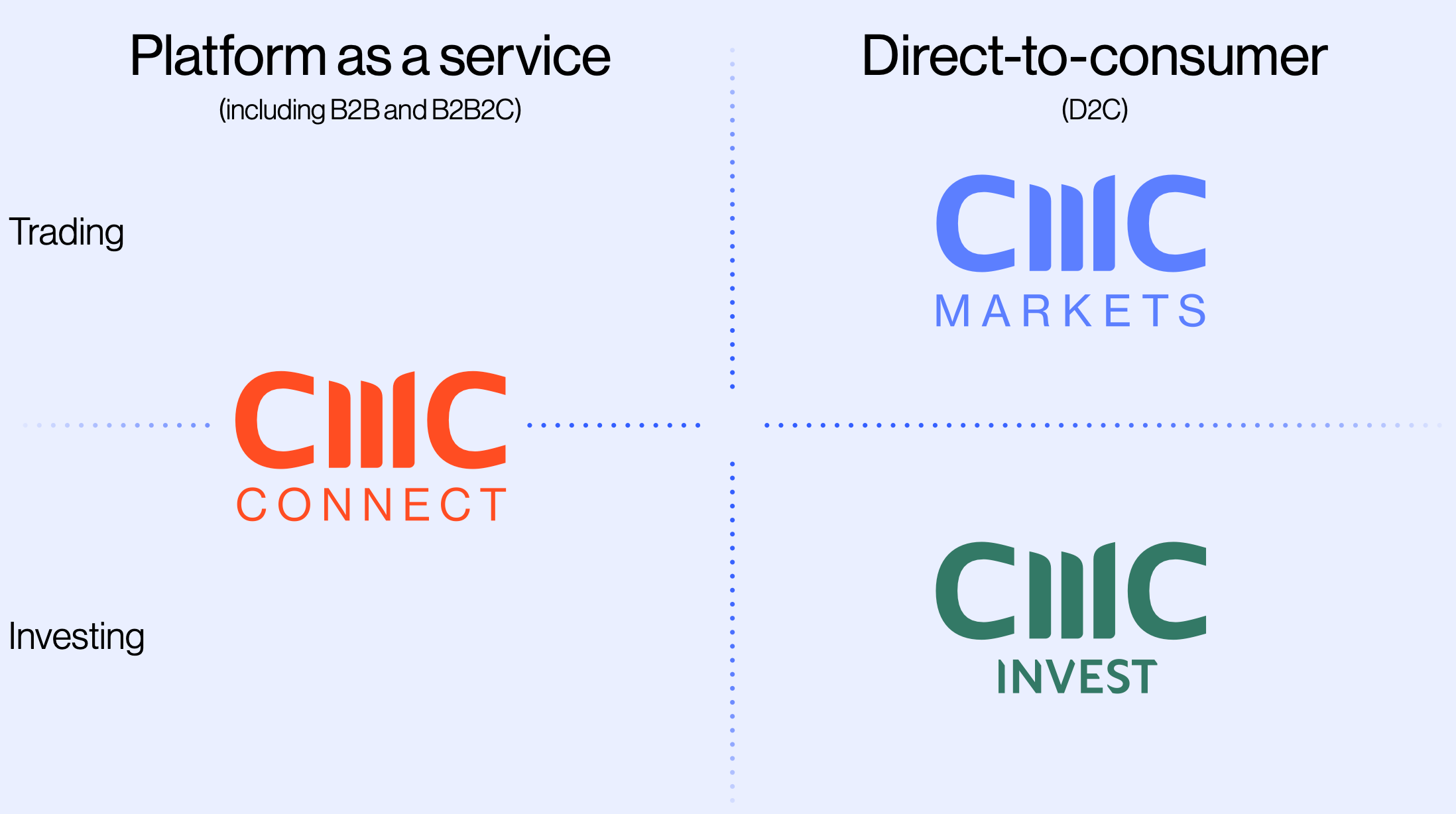
CMC Markets: ~54% of revenue from trading platform for retail/professional traders
CMC Connect and CMC Invest: ~33% from platform-as-a-service (white label platforms, e.g. providing CFD trading for Revolut in Europe, investment platforms etc.)
Interest income on own cash balances and client balances: 13% of total revenues. Interest income is particularly significant for profits since there is little direct cost associated with it - it was £42M in 2025: 50% of total profits.
CMC’s business model is not fundamentally changing over time, but they are making more products and services available in each of the areas above. This is discussed further in the growth section.
A key part of their business model is also that CMC successfully hedge the positions of their clients to avoid significant exposure to market movements.
Revenues are geographically split about 1/3 each in UK, Australia, and the rest of the world.
Competition and Market
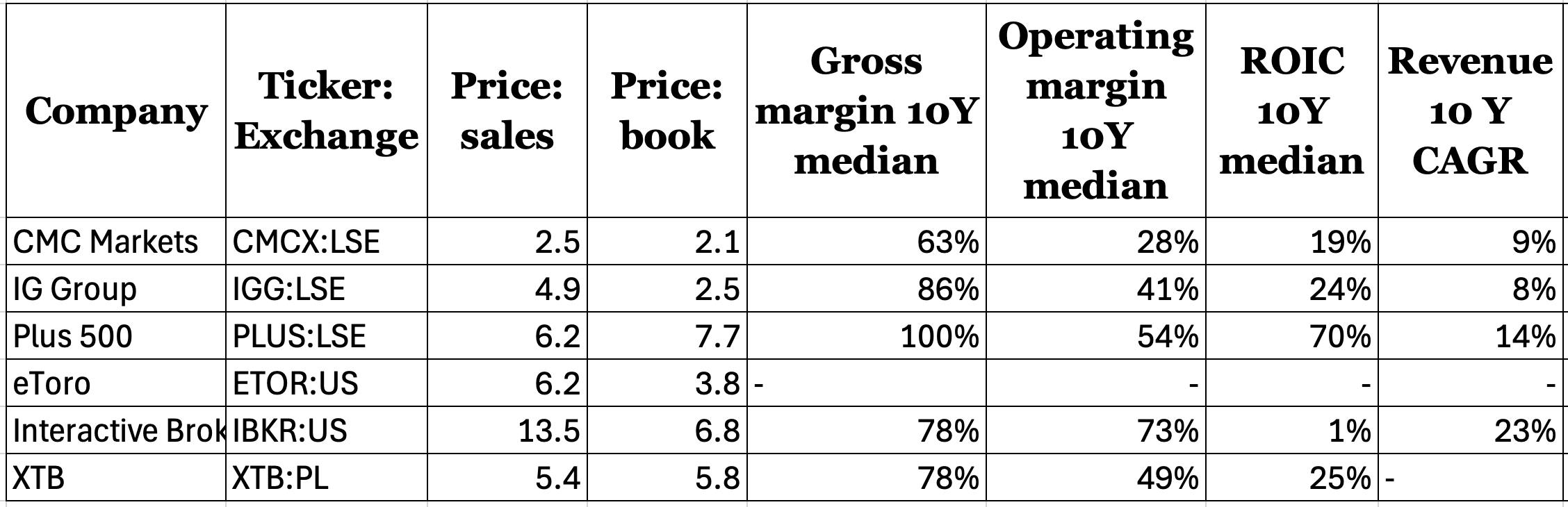
The table below shows various peers and competitors to CMC - this is at the original buy price of £3.20 per share for CMCX, who are priced at the lowest price:sales ratio, but have lower growth over the last ten years compared to major competitors.
Capital Structure and major shareholder
CMC have a single class of shares outstanding, and as of year end 2025, have £342M of net current assets, of which £248M is cash, with only £14M of non-current liabilities: so they have an extremely strong balance sheet.
CMC are controlled by their founder and CEO Lord Cruddas with a 59% stake, and over 60% combined with family holdings. He has said publicly that he has no plans to retire or ever sell any shares, and is 72 years old, so is likely to continue in his position for the foreseeable future. Therefore, the company strategy will be determined by him.
Capital Allocation
CMC has a dividend policy to pay out 50% of after tax profit. They do not buy back shares, and have not made any significant acquisitions: instead investing capital internally for organic growth.
Durability, Quality & Risks
CMC earnings are quite volatile: and correlate positively with volatility in the market - see the graph below. For 2021-2025, reported earnings average £80M, but reported earnings peaked in 2021 in the post-pandemic trading boom at £190M. Revenue in 2021 was about £450M, vs about £330M per year in the following years: so the extra revenue was very largely converted into profit during that boom year.
Owner earnings were calculated by the method recommended by Warren Buffet, to determine how much cash is actually flowing into the business. This is by taking reported post-tax earnings, adding back non-cash charges such as depreciation and amortisation, and deducting cash expenses such as capex and lease payments. Owner earnings averaged £108M in the period below, significantly higher than reported earnings of £80M, so the reported earnings understate the true earning potential of the business by about 35%. The reason for the difference was improvements in the working capital position - but this may not be sustainable over time, so I would expect owner earnings to approach reported earnings in future.
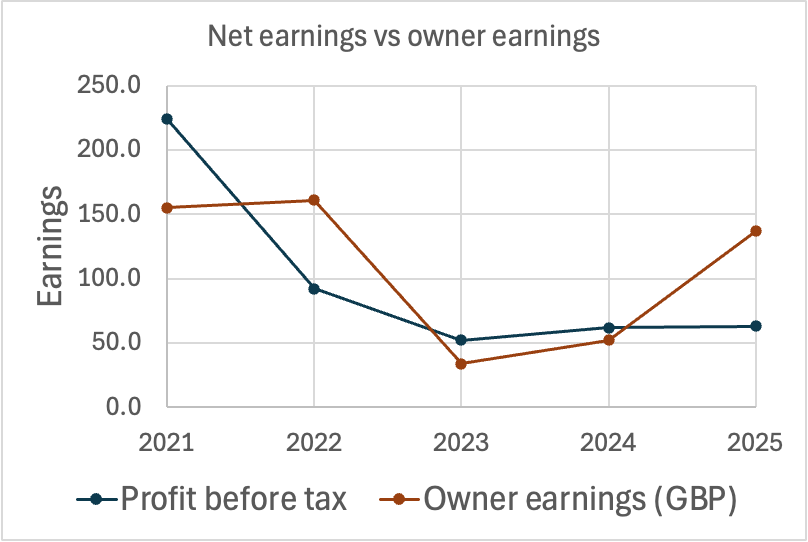
Since CMC does so well in periods of high market volatility, it is a great hedge against market volatility. Thus far in 2026, volatility has been higher in the commodity markets due to the Iran war, which should benefit CMC somewhat, though not to the extent of 2021.
The return on invested capital is high: at 19% median in 2016-2025, though it has averaged 14% since 2022.
Quality of earnings:
Risks
Liquidity risk: with financial companies, I always look at the risk that they will suddenly have insufficient funds to be able to meet customer demands or hedging requirements. CMC have a very low liquidity risk due to their huge cash reserves, and have an ICARA plan (internal capital and risk assessment) plan. At year end (March-2026) they had net current assets of around £370M, with around £280M of cash on hand, so liquidity risk is very low. They also have a £55M liquidity facility which can be used if needed.
Credit risk: they monitor exposure daily with counterparties, and have limits on credit exposure to intermediaries. The state that they only do business with investment grade counterparties - and in 2025 wrote off £3M in expected credit losses, <5% of profits - the same amount as in 2024.
Compliance risks: they do regular internal audits. Internal audits are managed externally by the audit firm Grant Thornton, which brings an element of independence to them which is positive.
Growth
There is some cyclicality to their business: when markets are volatile, trading volumes increase and since CMC makes most of its revenue and profits from brokerage commissions, this causes an increase in these measures. They said:
'Revenue is heavily influenced by customer activity and external factors such as market movements and volatility’
This effect can be very significant: in 2021 they experienced a high of £200M in profit, and in 2023 a low of £50M in profit. Due to high operating leverage, additional trading revenue translates into significant additional profit. The graph below shows how CMC’s gross profits have changed over time:
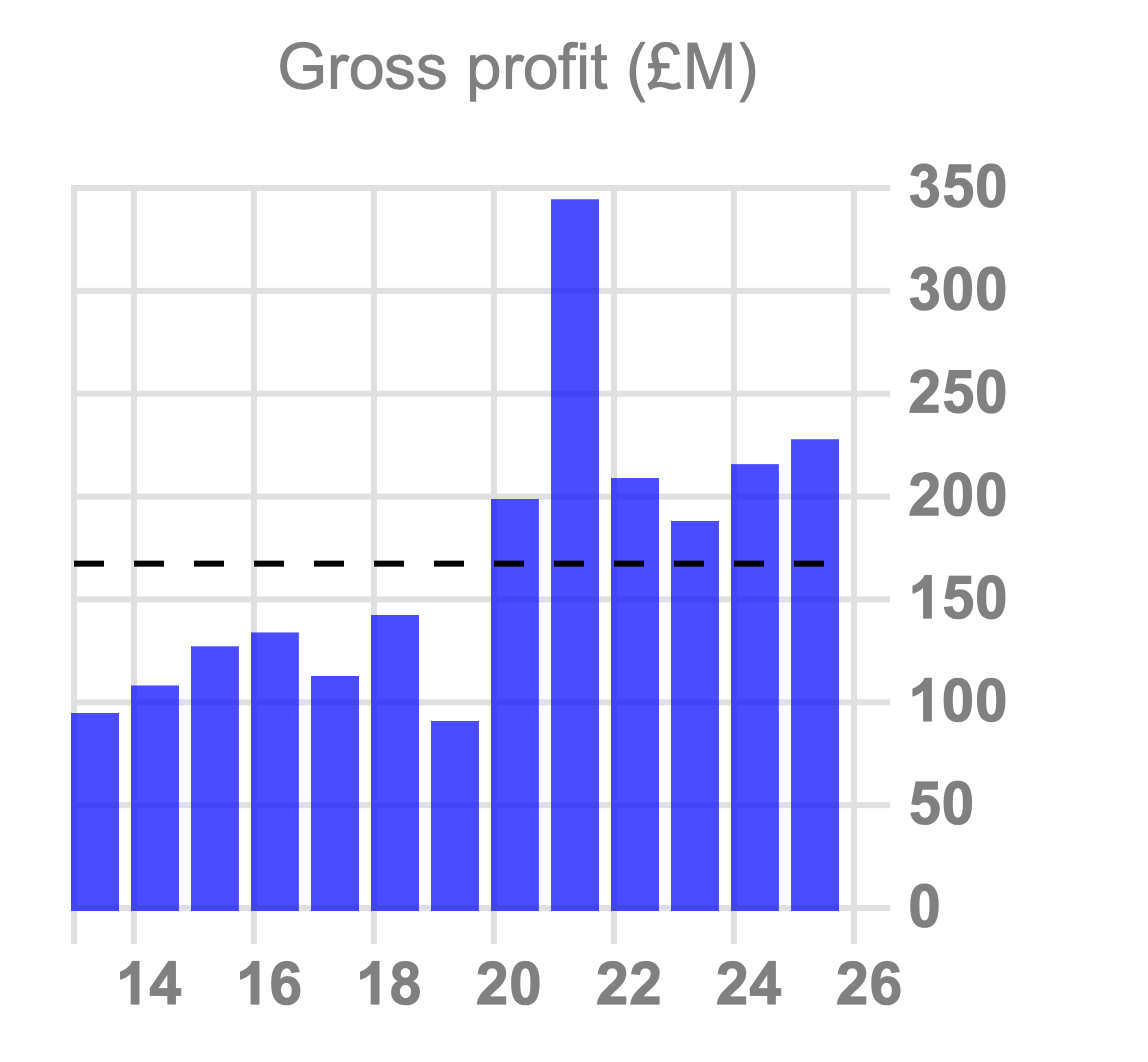
The effect of the large spikes in profits, is to mask the underlying growth trend in the company’s revenue and profits over time. The post-pandemic upswing in gross profits has been maintained for several years now.
Growth strategy
CMC is aiming to diversify its revenues into a wider range of products: reducing the percentage of revenues that coming from trading commissions, by focussing more on B2B - by expanding its institutional and investment offerings, to balance its current business which is driven by retail and professional trading. In order to do this, it has established external partnerships. For example, in mid-2024 with Revolut, which allows Revolut customers to access CMC’s trading services directly inside the Revolut app across Europe.
In April 2025, CMC partnered with TradingView, used by 100M investors and traders globally. This allows CMC clients to use TradingView charting and tools in the CMC apps and software platforms.
CMC also signed a partnership with ASB, a New Zealand bank, for an ASB-branded web and mobile platform to offer CMC’s investing and trading technology to ASB’s 1.5M customers, which should go live in late 2026.
Environmental, Social and Governance Factors:
Environment:
CMC Markets have just over 1000 employees, with average revenue per employee of £0.33 M. Their main environmental impact is their office space, but these use 100% renewable electricity.
Social:
CMC staff are fully office based, with no working from home - and employee morale was low in 2025 due to a layoff of about 140 staff in early 2024 to improve efficiency and restructure parts of the business. There is no unionisation of staff, mentioned in their workforce, in their annual report.
Governance:
CMC did a strategic review, and decided to:
Rationalise the number of companies across the group: they merged Opto Markets and CMC Invest to create a jointly operated and coordinated business unit targeting a single digital wealth proposition. They also made about 40 staff roles redundant in the process.
Implement a smaller, more strategically focussed board. Two directors left the board and moved into operational roles - David Fineberg became the Global Head of Strategic Partnerships, and Matt Lewis moved into an executive role as Head of ANZ.
The CFO Albert Soleiman stepped down and has been partially replaced by an internal promotion: John Cubbin. He is now CFO of the UK regulated entities of CMC Markets, which leaves the rest of the business without a specific named CFO at group level.
It took 9 months (Feb-Nov 2025) to partially replace the CFO; and that he was not fully replaced with someone in an equivalent role. CMC is a financial business - so I think that the CFO role is especially important. It is my opinion that CMC would benefit from having the role of a Group CFO, because then they will have overweight of all the activities of the group.
The board members are quite impressive, mostly with 20-30 years of experience in banking, capital markets, fund management, finance, etc. However, the founder Lord Cruddas owns 60% of the company, so he ultimately will be able to have total control over the composition of the board, and the strategic direction of the business. This means that a lot depends on his decisions.
External Audit:
The auditor of CMC is Deloitte, appointed in 2023, and internal audit is handled by Grant Thornton. In the last audit by Deloitte, there were several key audit matters:
CMC Germany: In a previous audit, structural and governance issues were found, the regulator required certain remediations in a two step plan (step 1 of which has now been completed), and a provision was created and remedial steps were taken to address the deficiencies. Access controls and segregation of duties were found to be insufficient. These issues had not been fully addressed by Mar-25, so the auditors needed do substantial checks, to verify figures in the trading statement, and could not rely on internal controls: so they visited the German and Austrian audit teams, and did risk assessments.
This is quite concerning, both that this occurred in the first place, and secondly the slow remediation - the auditors commented that some matters remained unremediated through a substantial portion of the financial year - though it is encouraging that these problems were picked up by the auditors. In a business such as CMC Markets, IT controls and appropriate segregation of duties are critical for the business.
Capitalised software development costs on internally developed software: £6M 2025, £12M 2024. A number of control matters needed addressing: relevant controls over capitalisation of staff costs and ongoing assessment of impairment conclusions on assets.
Appraisal
Free cash flow plus growth
In 2021-2025, CMC had total owner earnings of £540M, averaging £108M/year. At the time of recommendation to Real Worth Stocks Members on 13th February 2026, the share price was £3.20, and it is now £4.54, a rise of 42% in 115 days - or 207% annualised return. When originally recommended, the price:owner earnings was 8x, and it is now (7th June 2026) 11x owner earnings. The current share price represents an owner earnings yield of 9%.
Growth since 2022 has been 10% in total, or 3% per year - therefore the total return in the absence of a significant market volatility event boosting revenues and profits, is likely to be free cash flow of 9% plus revenue growth of 3% per year. This is just above that which could be obtained in the stock market overall - so there is little margin of safety remaining after the recent share price rise.
CMC Markets is currently benefiting from some volatility in the markets, which are hitting all-time highs in the US. If there is a downward shock and so volatility increases from here, CMC will see a benefit. However, in the absence of this, the margin of safety in terms of the valuation in the stock is no longer there.
Given mostly this, and also to a smaller extent, my concerns about the IT controls governance issues identified by the external auditor, I have sold the entire position in the stock, and taken the profit.
Disclaimer: this is not investment advice, and is for informational purposes only.
Disclosure: the Real Worth Stocks model portfolio now holds no position in CMC Markets (CMCX)