

This consulting company is relatively small compared to McKinsey, Bain Consulting Group and Boston Consulting, but growing 2x organically faster, plus through acquisition. I have analysed their business and projected a 15%-20% return in the stock going forward. The stock is…
Investment Thesis for Elixirr (ELIX)
Elixirr (ELIX) is a fast-growing consultancy firm listed in the UK, with experienced, entrepreneurial co-founders, with a significant combined shareholding, growing organically at mid-teens growth rates, plus more through acquisitions, with a total 38% revenue CAGR over the last five years. At current market price of 636p/share, it is at 20x 3-year average owner earnings, or a 5% owner earnings yield, so should deliver an above-market return, through continued strong organic growth and acquisitions. It is capital light: not requiring much working capital to grow, because customers are billed and pay monthly for services rendered. The company uses AI operationally, and also helps companies adapt to disruption/take advantage of AI, so the business model should prove resilient to the effects of AI. Elixirr is competitive with the big consulting companies: MBB (McKinsey, Bain and Boston Consulting), and is rated better on a number of measures in customer surveys. Finally, Elixirr may be acquired at some point should the management team decide to sell, but this is not required for the investment case.
Business Model
Elixirr is a consulting company, co-founded in 2009 by Stephen Nelson and Daniel Busby after leaving their roles at Accenture. Elixirr describe themselves as a ‘challenger consultancy,’ competing with MBB (McKinsey, Bain and Boston Consulting Group). Their business model is to take on individual and ongoing consulting projects with their clients, who are typically large companies – in 2025 they had 250+active clients: a selection of their clients is shown below.
Project teams are typically about three people: one or more partners supported by junior staff. They create board-level solutions to client problems, e.g. technological disruption, new products, project management and major change programmes, and help the clients implement the solutions. Revenue is earned from charging for time and materials, fixed fees and performance related fees.
AI - threat or opportunity?
Elixirr says that there is growing demand for AI-related consulting:
‘…AI as the fastest growing area. A growing proportion of consulting reflects increased demand for strategy-led consulting, execution, and C-suite advisory, as clients seek guidance on AI-driven transformation and broader strategic priorities, supporting sustained organic growth.’
AI related work is the fastest-growing area of their business – comprising 7% of their current business, with digital another 8% and data 18%. They also use AI internally to improve operational efficiency: e.g. cutting the time to generate client proposals by 90%. The chart below shows how their capability mix has changed over time.
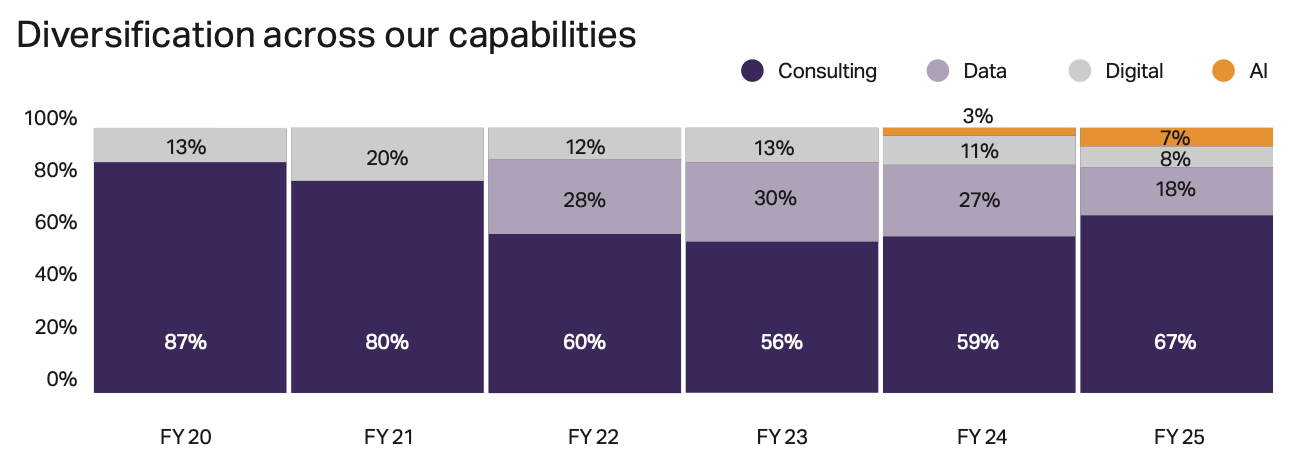
They bought Responsum in 2023: an AI company that helps businesses manage data privacy, GDPR compliance, risk tracking, and tracks AI usage across the organisation. Elixirr state that they have been building their AI internal capability since 2015. Elixirr’s product offering includes bespoke AI solutions, e.g. proprietary AI agents to clients. However, traditional consulting still comprises about 2/3 of their business.
People and incentives
Consulting is a people-driven business: and Elixirr state that people are key to their success. Every employee is mentored/coached by a partner, to help develop them. They aim to preserve an entrepreneurial spirit, ownership mindset and commitment to excellence along their people – and were 417 applications per role available in 2025, so it is seen as a desirable place to work. They have a senior led business: partners are given share options to incentivise them, vesting over 4-6 years. Every partner and all of the directors have equity in the business - and the CEO and Deputy CEO hold 1/4 of the company between them. In 2025, 84% of employees were enrolled in the employee share scheme.
Clients and markets:
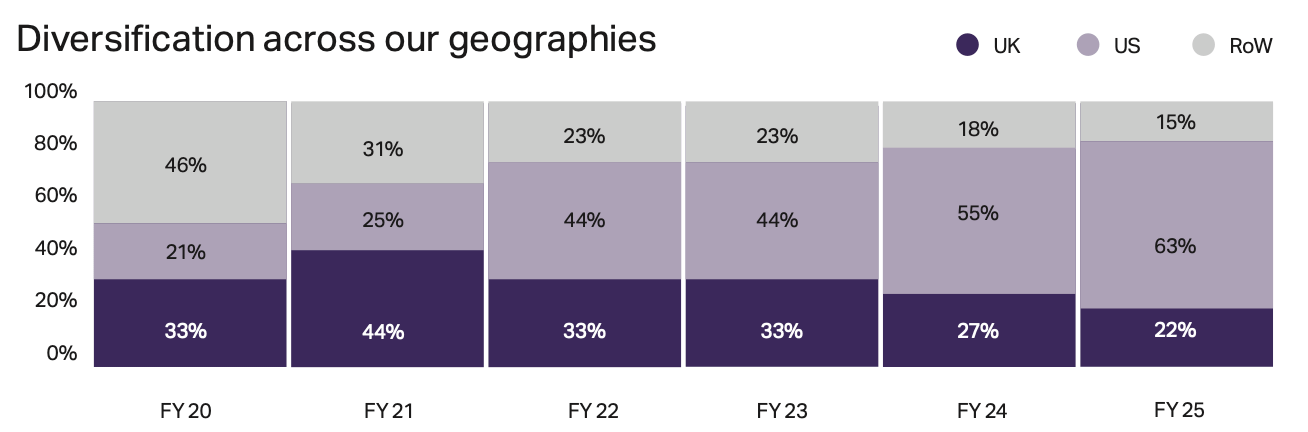
The founder Stephen Newton is a qualified accountant and was a financial services partner at IBM, and then he and the other co-founder Graham Busby both worked at Accenture, so Elixirr’s initial client mix was mostly financial services and insurance, but over time has been diversified across multiple industries as above. Geographically, management are executing their strategy to focus on expansion in the US: the largest global market for consultancy services, so this now makes up about 2/3 of their revenues.
Competition and Market
Elixirr is compared below to other consulting companies - standing out for its high growth. Charles River Associates International (CRAI) listed on the Nasdaq (CRAI), a specialist economic, financial and management consulting firm in the US, ICF International, a consulting and technology services company, have a similar size to Elixirr (2x-4x larger), but much lower operating margins, and single digit growth.
Accenture (CAN) does technology build-out, strategy, digital transformation and modernisation of operations. Accenture has 15% operating margins, with high single digit revenue growth, but operating margins are very variable - Elixirr has the most stable operating margins of all these companies.

Elixirr said that its key competitors are the big four accounting firms: KPMG, PwC, EY and Deloitte, plus MBB (McKinsey, Bain and Boston Consulting Group) – and Elixirr’s clients see MBB as the direct competition. MBB companies are all growing in the single digits, and are huge compared to Elixirr: all at least $7B market cap,
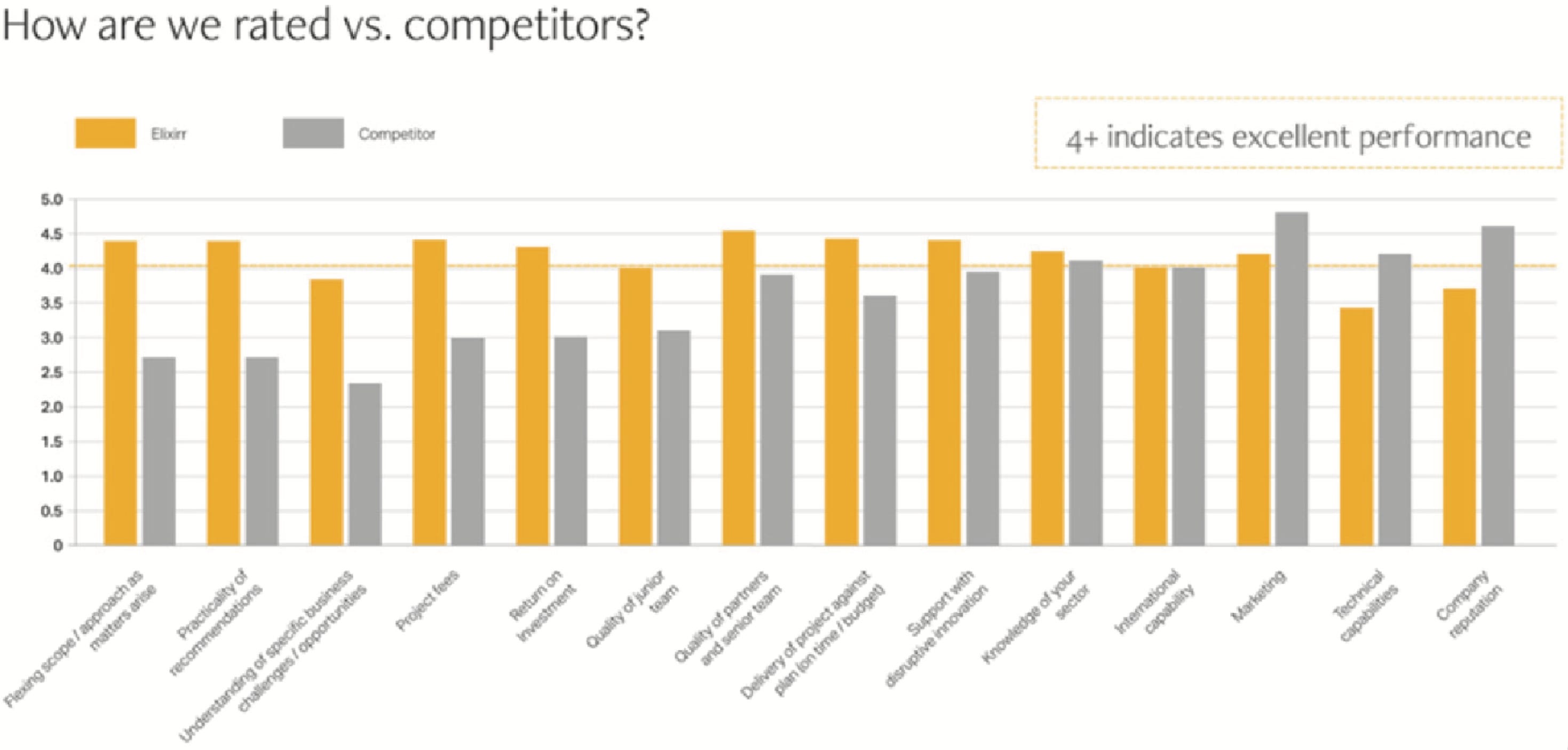
The top differentiators between these Elixirr and MBB from customer surveys were:
- being more flexible on the scope when required
- making more practical recommendations
- understanding specific business challenges
- junior staff and partner quality
- better ROI.
Overall, Elixirr is smaller, more flexible and nimble, with more highly talented staff who are very focussed on creating actionable strategies, which deliver client ROI.
Consultancy is a low barrier to entry industry – requiring very little capital to enter the business. However, client relationships built up over time by talented consulting partners can differentiate a consulting company, and are key for customer retention. Elixirr has a number of clients who are engaged over periods of years: with 27 clients spending more than £1M in 2024, and 34 in 2025. The chart below that over most metrics, Elixirr is rated better than MBB: except for marketing, technical competence, and company reputation. Marketing and company reputation can be explained by the size of MBB companies, and technical competence since they have a more diversified offering: but Elixirr is building capabilities in this area through acquisition.
Capital Structure
Elixirr has a single class of common stock with no special voting rights.
Capital Allocation
Elixirr is a capital light consultancy business, and so almost all of the earnings are available for acquisitions, share buybacks, and dividends. However, capital is also used for the following purposes, which do not directly benefit public shareholders:
The net cost of purchases and sales of shares via the employee benefit trust - though this reduces dilution by preventing new share issuance.
Shareholder loans: At FY 2025 end, Elixirr had £8M of interest free loans outstanding to shareholders: these are interest free loans given to group senior employees, e.g. partners and directors, to help them purchase an equity stake in the business, and they are secured on the shares: which will only be released to the shareholders when the loans are repaid. This is a part of the way that Elixirr incentivises its partners and directors.
Elixirr also pays about £1M in tax per year to cover the benefit of giving its employees interest free loans - the shareholder loans mentioned above.
The effects of this capital allocation on the quality of earnings is discussed below, and it is taken into account when calculating owner earnings.
Durability, Quality & Risks
Quality of earnings:
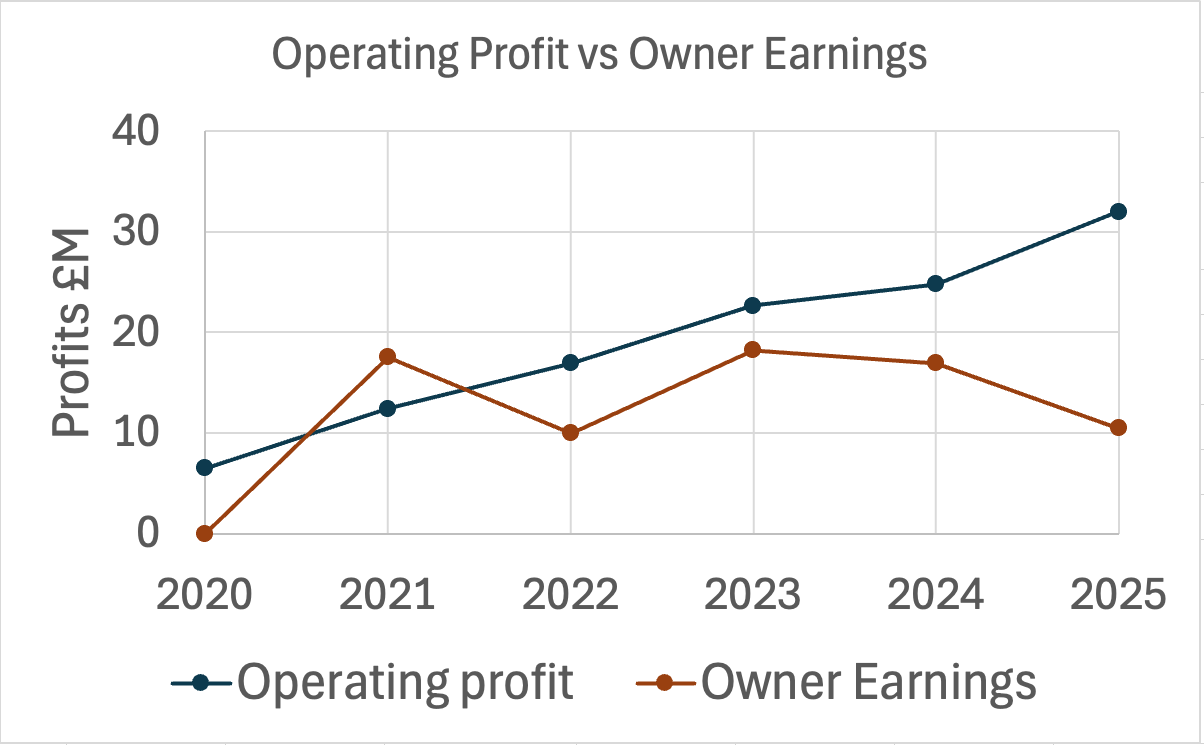
Owner earnings calculated using Warren Buffet’s method, are below operating earnings.
Elixirr is very cash generative, and also operates with minimal working capital, as clients are billed monthly for their services: so almost no capital is required for organic growth. The acquisitions Elixirr makes usually have a substantial portion of goodwill associated with them, which is amortised over time. This non-cash expense reduces net reported earnings, and taxes.
However: Elixirr spends a significant amount of cash to buy shares into its Employee Benefit Trust, which are then sold to employees, or awarded to directors. Due to a board transition in 2025, with a change of CFO, about 0.65M shares were awarded at nil cost - the board says this is a one-off, resulting in a net £13.7M being spent on the employee benefit trust share purchases in 2025. This significantly reduces owner earnings as the graph below shows. Other 2025 contributors to lower owner earnings were: taxes and interest (about £10M), net interest and working capital changes (about £4M). management stated that net employee benefit trust payments without the board transition would have been about £8M: which would boost owner earnings to about £15M: but this is still a price:owner earnings of 20x for 2025.
When valuing Elixirr, I will take into account owner earnings rather than operating profit.
Risks
Loss of partners leading to loss of key client relationships, and lost business: this is mitigated by having a ‘single count and double count partner model,’ so that key client relationships are not limited to one person.
Elixirr also compensates its partners well, with share awards which vest over 5 years, and giving them matching shares, which helps to keep them with the business.
Disruption from AI:
Many of Elixirr’s clients are facing disruption from AI. However, I do not feel that this is a big risk for Elixirr. They provide strategic advice to large companies, who will want their consultants to use AI tools to improve their efficiency, but not want to replace their consultants with AI for making strategic decisions: because the decisions are too important to rely solely on AI.
The risk is more that the relative demand for different types of consulting could change, and unless Elixirr offers more AI-related services, demand could reduce. However, they are pivoting to take this into account with the acquisitions.
Elixirr have not been through a significant recession since IPO.
Growth
Elixirr was founded in 2009, and did an IPO on AIM in the UK in 2019, joining the main market of the LSE in 2025. They grew the business from zero revenue in 2009 to £21M in 2019, to £149M in 2025, a 2019-2025 CAGR of 38%. The growth from 2019 to 2025 included nine acquisitions: the largest of which was TRG in 2025.
Growth strategy:
1. Stretch existing partners to grow existing client relationships
2. Hire new partners with the key skills needed
3. Promote partners from within: 32% of revenue comes from internally promoted partners
4. Acquire new businesses: aiming for 1-2 per year, utilising dedicated internal M&A team
In 2025, growth was 15% organic, and 19% from acquisitions.
Acquisitions:
Elixirr has done nine acquisitions since IPO in 2019, of which the largest is TRC advisory, a US consultancy, and the next biggest Hypothesis, then Kvadrant: all within the last 2 years.
Typically, a significant proportion of the consideration is contingent on the acquired business achieving certain required profit milestones post acquisition, and is accounted for accordingly: for example the TRC acquisition in September 2025, had a total consideration of £89M, of which just under half was an upfront payment of £30M in cash and £11.7M Elixirr shares at £8.20/share. There will be a further payment of £21M in cash and shares in early 2026 depending on FY2025 performance, and then a final £26M in cash/shares to be paid over three years (2026-2028) contingent on meeting performance targets.
TRC had 2024 revenues of £19M and operating profit of £9M: so Elixirr paid about 9x 2024 earnings: though about 25% of the final consideration will be paid over 2026-2028. In 2025, TRC had revenues of £28M, about 40%+ higher than 2024, so it is growing fast and Elixirr’s management say that it’s performance is tracking above expectations.
Since IPO Elixirr has diluted their share count from 45M to 53M shares, or 2.4%/year. In this time, post-tax profit has increased from £1.3M to £21.4M, at a CAGR of 49%, and balance sheet net tangible assets have decreased from £-4.5M to -£27.6M. Their assets are intangible: goodwill and brands etc. from their acquisitions. Therefore, I would conclude that the acquisitions have added significant value over time.
Environmental, Social and Governance Factors:
Environment:
Elixirr is a consulting company, so has a very small direct environmental impact, as their operations consist of mainly of leased office space.
Social:
Elixirr gives its staff days off to do non-profit consulting on a pro-bono basis, and also has a Early Careers Programme partnership with 26 academy schools in London : and the Elixirr AI and Data Academy in South Africa develops high potential graduates to build a talent pool for the business.
Governance:
Elixirr has three executive directors, including Stephen Newton, the co-founder who holds 23% of shares, and Graham Busby, who holds 3.5% of the shares, and Nicolas Willott the CFO, appointed in 2025.
Therefore, the executive directors hold a very meaningful stake in the company, so their interests are aligned in this respect with the other shareholders.
Stephen Newton (CEO and chartered accountant, experience in transformational change) and Graham Busby (Deputy CEO) (marketing, sales, large consulting deals) both worked for Accenture prior to founding Elixir, and between them have many years experience in consulting.
The new CFO Stephen Willot was previously finance director, and is chartered accountant, and worked in M&A advisory.
There are four very experienced non-executive directors on the board, all appointed in 2025, including the independent NED chair Gavin Patterson, was previously CEO of BT from 2015-2019. During his BT tenure, he led the £15B acquisition of EE, launched BT Sport and also was the chief revenue officer at Salesforce from 2019-2023.
Audits:
External audit was carried out by Crowe UK LLP, based in London, appointed in 2020 - with Matthew Stallabrass the senior auditor.
Key audit matters were:
1. Carrying value of goodwill: Goodwill is very significant: £173M of intangible assets. The auditors reviewed and challenged managements’ assumptions, and did their own valuations, and also retrospectively checked management’s forecasting accuracy.
2. Revenue recognition: they performed detailed testing on a sample of open-ended contracts, checking alignment of billing of work carried out, and also checked customer communications to assess level of completeness of work at year end for projects without timesheets, to check they matched management statements.
3. Risk of fraud: the auditors determined the greatest risk of fraud was from override of controls by management, so they examined supporting documents to verify materials balances, transactions and disclosures, and reviewed management correspondence.
The auditors did not find any matters of concern to report.
Appraisal
1. Free cash flow (owner earnings) plus growth.
I have calculated an owner earnings yield for Elixirr of 5%, based on average owner earnings over the last three years (see Quality of Earnings section). Growth is both organic and inorganic. If we disregard inorganic growth, since that is paid for through cash and shares, and look at organic growth only: it has averaged 14% per year over the last three years. Share dilution is about 2.4% per year: so in total I would expect 15%-20% annual return in the stock. Since IPO in 2019, the stock price has returned a CAGR of 19%, and 21% including dividends: which is very close to my estimate of return from owner earnings plus organic growth.
2. P/E multiple.
Price: earnings: an average of the last three years reported net earnings is £18M, for a P/E ratio of £315M market cap/£18M net earnings = 17.5, which is reasonable given the average 14% organic revenue growth.
Disclaimer: this is not investment advice, and is for informational purposes only.
Disclosure: the Real Worth Stocks model portfolio holds a long position in Elixirr (ELIX) at the time of writing.